What Is Concrete Cancer? Causes, Signs & Repair. Australian Owner's Guide
If you own an apartment, manage a strata scheme, or look after any concrete building near the coast, you've probably heard the term concrete cancer. It's one of the most common. and most misunderstood. defects we deal with across Wollongong, the Illawarra and the South Coast. This guide explains what concrete cancer actually is, why it happens, how to recognise it, and what a proper repair looks like.
What is concrete cancer?
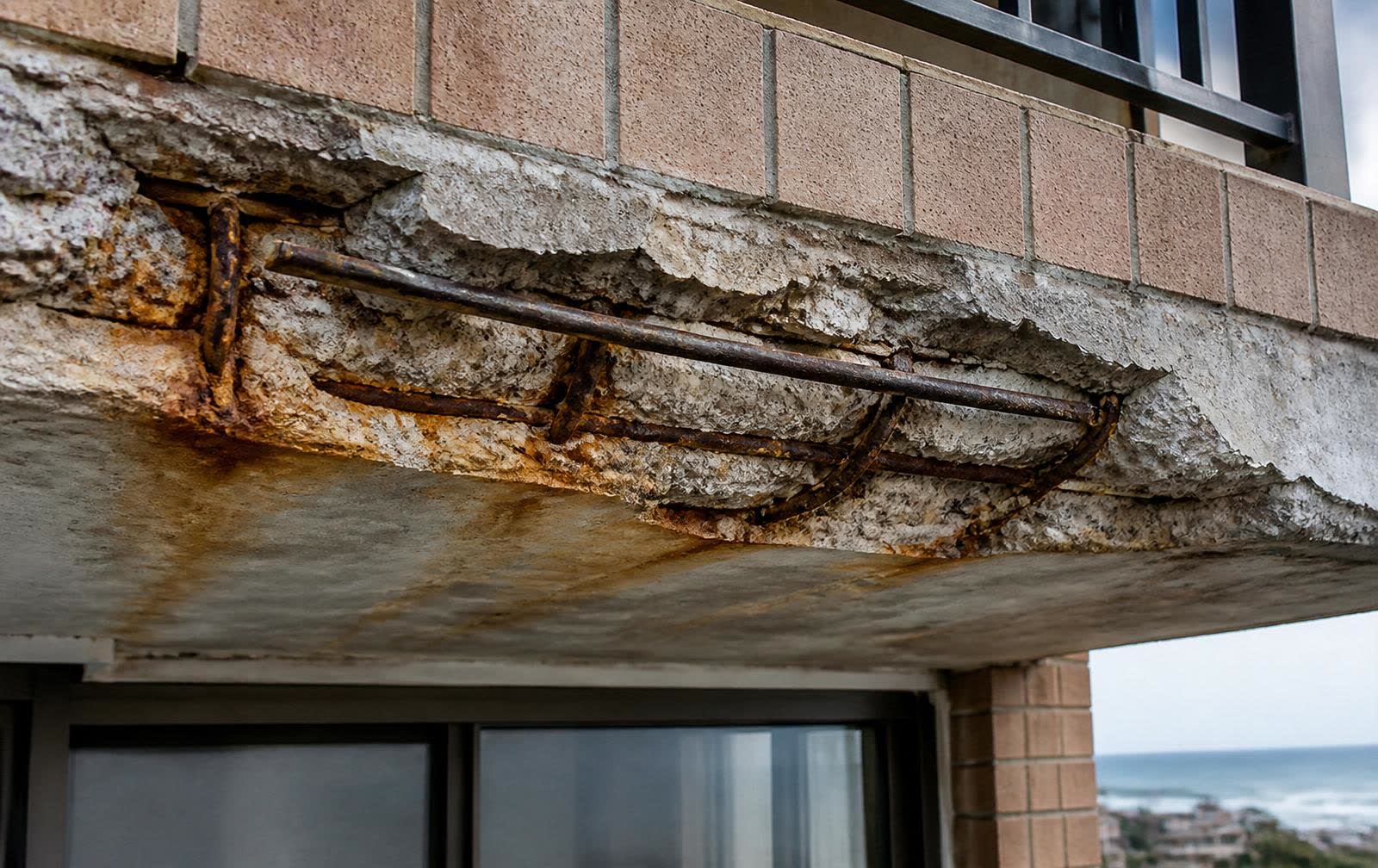
Concrete cancer is the common name for reinforcement corrosion inside concrete. Reinforced concrete works because steel bars (rebar) are embedded inside the concrete to carry tension loads. When those steel bars start to rust, they expand. up to seven times their original volume. and that expansion cracks and blows off the surrounding concrete. That's the visible spalling you see on old balconies, soffits and facades.
The technical term is reinforcement corrosion-induced spalling. The everyday Australian term is concrete cancer, and the name is accurate: left untreated, it spreads.
What causes concrete cancer?
Two chemical processes are behind almost all concrete cancer we see:
- Chloride ingress. salt from sea air (or salt water) penetrates the concrete over time. Once chloride levels at the steel exceed a threshold, the passive layer protecting the rebar breaks down and corrosion starts. This is the dominant cause in coastal buildings from Sutherland Shire down through Wollongong to Shoalhaven.
- Carbonation. CO₂ from the atmosphere reacts with the alkaline concrete and gradually lowers the pH from the surface inward. When the carbonation front reaches the steel, the protective environment is lost and rusting begins. Common in older inland structures and car parks.
Three site conditions make it worse: low concrete cover to the reinforcement (common in 1960s,1990s balconies), cracking that gives water a direct path to steel, and failed waterproofing on decks, balconies and planter boxes.
How to spot concrete cancer early
Early detection makes repairs dramatically cheaper. Look for these warning signs on balconies, soffits, columns, retaining walls and facades:
- Rust staining. orange-brown streaks bleeding from cracks or joints, usually the first visible sign
- Cracking in straight lines that mirror the reinforcement pattern below the surface
- Bulging or bubbling in painted or rendered surfaces
- Spalling. pieces of concrete falling off, exposing rusted rebar underneath
- Hollow-sounding concrete when tapped with a hammer (a licensed remedial builder will 'sound' surfaces to map hidden delamination)
- Water staining on soffits below balconies or planter boxes
If you can see exposed rusted steel, the damage has already been progressing for years. Don't paint over it. that traps moisture and accelerates the corrosion.
Why coastal Australian buildings are especially at risk
The Illawarra coast has almost every risk factor stacked together: constant salt-laden onshore winds, high humidity, older strata stock built with lower cover-to-steel standards than today's code, and thousands of balconies and roof decks exposed directly to weather. That's why concrete cancer repair is such a common line item on capital works plans for buildings from Wollongong through Kiama, Shellharbour and down to Nowra.
What proper concrete cancer repair actually involves
This is where most bad repairs fail: someone patches the visible spall with a bag mix, paints over it, and calls it done. Two years later it's worse. A correctly executed repair follows a documented sequence:
- Diagnostic inspection. hammer sounding, cover-meter surveys and (for larger jobs) half-cell potential testing to map the true extent of corrosion beyond the visible damage.
- Break-out. the affected concrete is removed back to sound substrate, with at least 20 mm behind the corroded reinforcement so the steel can be fully cleaned on all faces.
- Steel preparation. reinforcement is mechanically cleaned to Sa 2½ standard and treated with an anti-corrosion primer.
- Reinstatement. a polymer-modified repair mortar compliant with AS 1478 is applied in controlled lifts.
- Protection. an anti-carbonation or elastomeric protective coating is applied to block future chloride and CO₂ ingress. In high-chloride environments, galvanic anodes may be installed to halt ongoing corrosion in the surrounding steel.
- Documentation. photographic records at every stage, materials data sheets, and a written warranty for the strata records or property file.
How much does concrete cancer repair cost in Australia?
It depends entirely on access, extent and coating scope. As a rough guide, based on jobs we quote across Wollongong and the South Coast:
| Scope | Typical range (AUD) | Notes |
|---|---|---|
| Small localised spall repair | $2,500. $8,000 | Single balcony edge or column, ground access |
| Single-balcony full repair + coating | $8,000. $25,000 | Includes break-out, treatment, reinstatement, protective coating |
| Full building facade / capital works | $150,000. $750,000+ | Multi-storey strata, swing stage or scaffold access, phased delivery |
Fixed-price line-itemised quoting is the industry standard for reputable remedial builders. if you're being given a lump sum with no breakdown of m² of break-out, coating type or reinforcement treatment, ask why.
Can concrete cancer come back after repair?
Yes. if the root cause isn't addressed. A repair that only patches visible spalls without treating adjacent at-risk reinforcement, or without applying a protective coating, will typically see the problem return within three to five years. That's why we specify galvanic anodes in high-chloride locations and always finish with an anti-carbonation coating. the goal is to add decades, not months.
When to call a specialist
Call a licensed remedial builder for a diagnostic inspection if you see any of the warning signs above, if your strata capital works plan flags concrete repairs coming due, or if an insurer or NCAT process needs a documented scope. Don't call a general painter or handyman. concrete cancer repair requires specific product systems, compliance with AS 1478 / AS 3600, and documentation that stands up to insurance and Tribunal scrutiny.
South Coast Remedial provides diagnostic inspections and fixed-price concrete cancer repair quotes across Wollongong, the Illawarra, Shoalhaven and the Southern Highlands. Call +61 468 071 088 or request a site assessment via the enquiry form.
Talk to a Remedial Building Expert
Free, no-obligation assessment across Wollongong, the South Coast, Shoalhaven & Southern Highlands.
Call: +61 468 071 088